
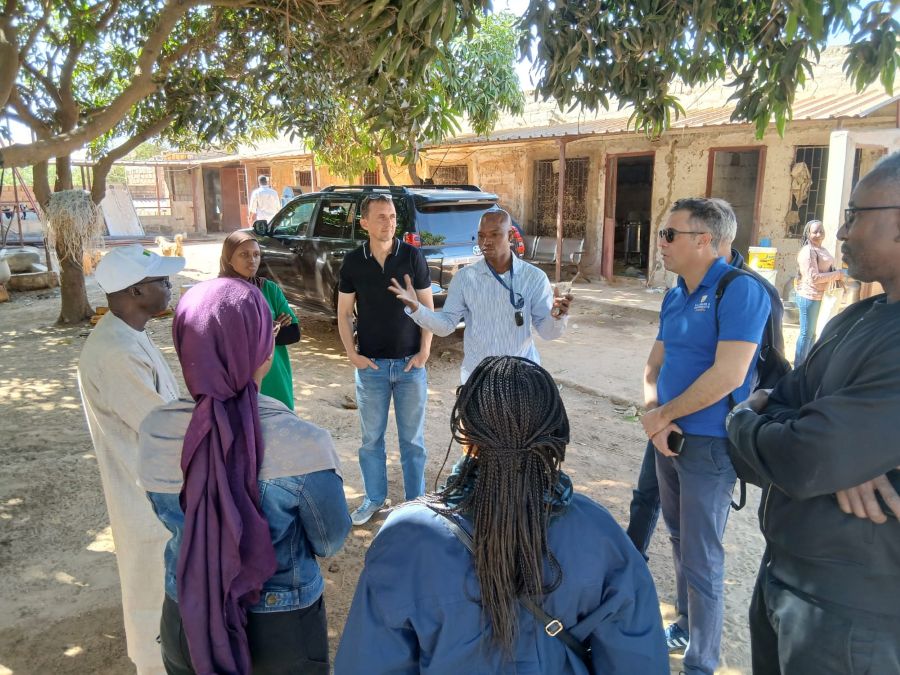
Recently, U.S. Grains & BioProducts Council (USGBC) Deputy Regional Director for Africa Mohamed Salah Bouthour led a delegation to Senegal to oversee a training seminar for poultry industry stakeholders to help maximize production at a variety of farms across the country and offer a workshop for a major feed producer to enhance customers’ outputs.
USGBC partnered with the Poultry Association of Senegal (IPAS) to deliver a third and final in-country poultry training workshop in 2025, hosted at the Reference Center for Poultry Professions in Diamniadio. This activity marked the first formal collaboration between the Council and IPAS, establishing a new model for locally led, industry-based training in West Africa.
Simultaneously, and in response to a request from NMA Sanders, one of the largest feed millers in Senegal, the Council expanded its impact into Senegal’s dairy sector by sponsoring a three-day ruminant management program led by experts from the Council’s Regional Feed Training Center in Tunisia. The program combined on-farm visits, farmer workshops and staff training addressing dairy cow nutrition, farm management and profitability.
“Senegal is reliant on imports of milk due to an under-developed domestic production network, leading to higher consumer costs, and providing technical assistance will help expand capacity and therefore raw material demand,” Bouthour said.
“On the poultry side, the training sessions were a continuation of our ‘train the trainers’ initiative, where the Council instructs local leaders in advanced agricultural techniques so they can improve nutrition levels in their communities.”
Unlike previous programs, the training adopted a hands-on, inclusive approach, engaging poultry producers, on-farm feed mixers and commercial feed manufacturers. Experienced participants were selected by locally trained trainers, who also identified two priority poultry regions that will serve as pilot hubs for future activities.
In three days, the 50 participants strengthened their knowledge of poultry management, processing, feed formulation and the effective use of U.S. corn co-products in poultry diets, reinforcing both technical capacity and market familiarity.
“As the Council continues to strengthen relationships with local stakeholders through these training sessions, we can repeatedly demonstrate the nutritional and economic advantages of U.S. corn and corn co-products,” Bouthour said.
“Our goal is to create a lasting foothold for U.S. agricultural goods in Senegal and surrounding markets, and we hope that by improving producers’ formulations and practices, end users will gain trust in the products we can offer.”
Learn more about the Council’s work in Senegal here.