
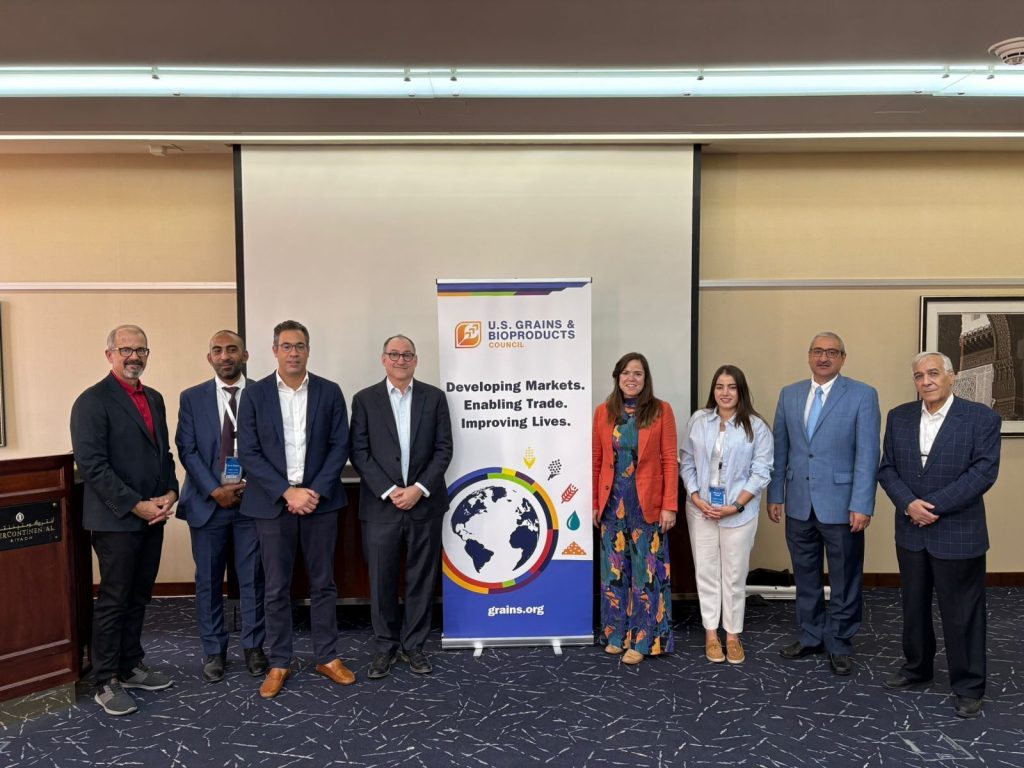
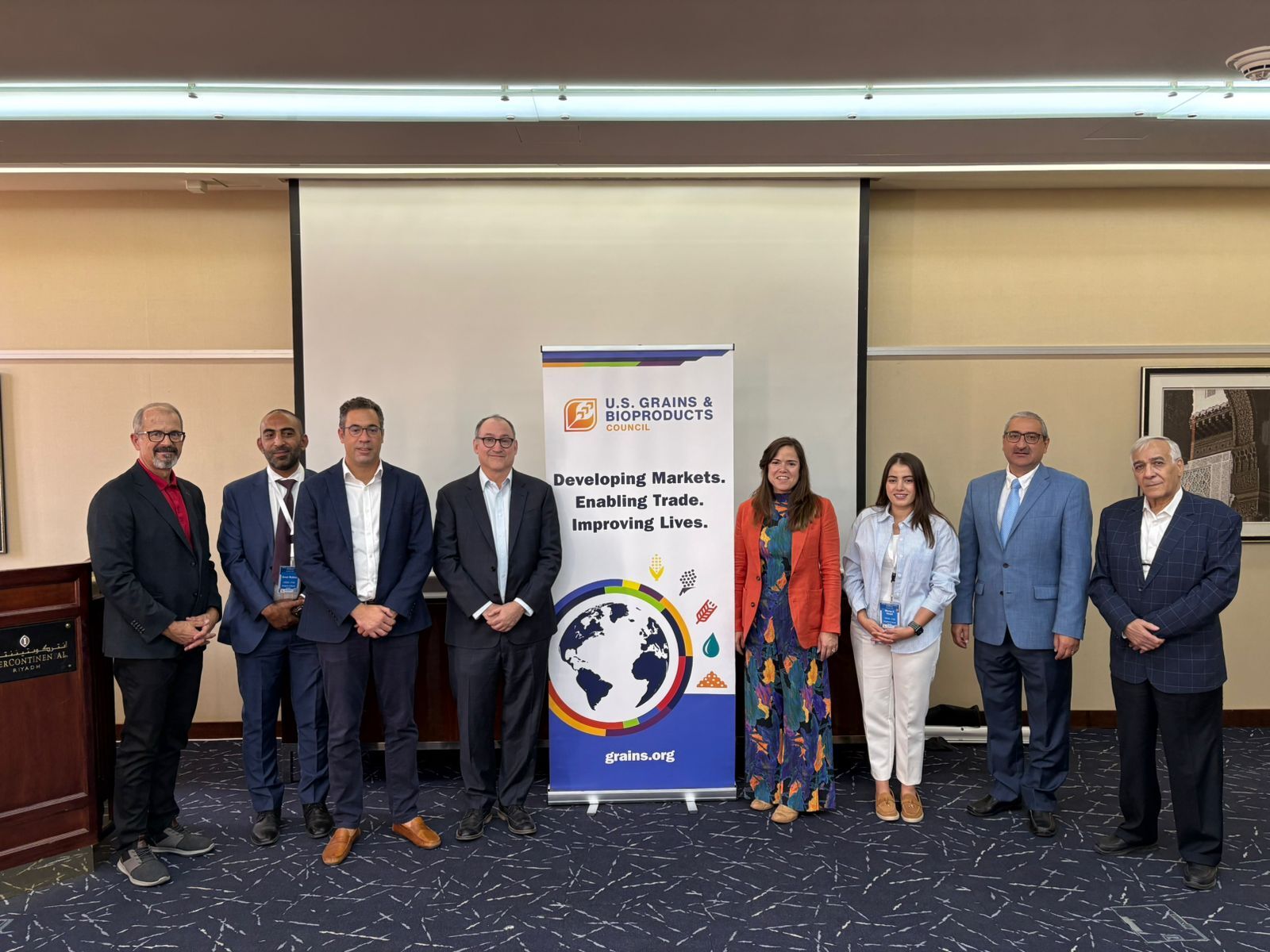
U.S. Grains & BioProducts Council (USGBC) Regional Director for Europe, the Middle East and Africa (EMEA) Ramy H. Taieb and Deputy Regional Director for Africa Mohamed Salah Bouthour recently traveled to the Kingdom of Saudi Arabia (KSA) to meet with local feed, poultry and large animal producers and organize a workshop session to promote U.S. corn, corn co-products and sorghum.
The Council’s delegation met with leading feed companies in Dammam, Riyadh and Jeddah and visited storage facilities to learn about the challenges they face – both in the marketplace and due to climate constraints – and held a conference gathering leading customers from across the country to highlight the best storage practices and nutritional advantages of U.S. grains and co-products.
“While feed producers in Saudi Arabia possess advanced grain handling infrastructure, exemplified by the Arabian Agricultural Services Company’s (ARASCO’s) state-of-the-art port facility in Dammam, significant challenges persist in grain storage due to extreme heat and humidity, resulting in shrinkage and sanitation issues,” Taieb said.
“We also identified an opportunity to promote U.S. sorghum thanks to its competitive price and availability, as well as its added nutritional value in poultry and dairy feed diets.”
At the storage and nutrition conference in Riyadh, U.S. industry experts spoke to 25 high-level representatives including question-and-answer segments that facilitated increased awareness of corn-fermented protein (CFP) and distiller’s dried grains with solubles (DDGS), nutritious corn co-products that can vastly improve animal diets.
“Our audiences were eager to learn from the U.S. industry, leading to quite a few discussions between Saudi grains buyers and U.S. members, building synergy for future business in the country. This is due to the notable progress in Saudi poultry production, that has reached 70 percent self-sufficiency with expectations to achieve full self-sufficiency in the near term, requiring more corn and corn co-products,” Bouthour said.
“The Council looks forward to organizing further events in KSA involving more U.S. agribusinesses to help capitalize on U.S. products’ price competitiveness and nutritional performance that can give U.S. agriculture an advantage in the Arabian Gulf.”
Learn more about the Council’s work in Saudi Arabia here.